






Sauna Heaters & Wood Types Explained
(Cedar, Hemlock, Nordic White Spruce)
A beautiful sauna can still be disappointing if two decisions are wrong: the heater and the wood.
The sauna heater determines how effectively the room reaches and holds temperature, how the heat feels, and the quality of the steam when water hits the stones. The wood affects everything your body actually touches, from how hot the bench feels against your skin to how the room smells and handles repeated swings in heat and humidity.
For Wisconsin homeowners planning a new sauna, those choices deserve more attention than finishes and accessories. Here’s how to make them, using the Tylö sauna range Bachmann’s carries as a practical reference point.
How to Choose a Sauna Heater
Start with the room, not the heater.
An electric sauna heater is sized primarily according to the sauna’s volume, measured in cubic feet. Floor area alone doesn’t tell you enough because ceiling height changes the amount of air the heater needs to warm.
Construction matters too. Glass, stone, tile, and other uninsulated surfaces increase the effective heating load. Tylö’s installation guidance, for example, accounts for glass when determining appropriate heater output.
Heater design also changes the experience. Wall-mounted models preserve floor and legroom, while floor-standing heaters can become a visual centerpiece. Stone capacity matters because the stones absorb and release heat and produce löyly — the burst of steam created when water is poured over properly heated sauna stones.
The goal isn’t simply to buy a heater powerful enough to make the room hot. It’s to match the heater’s kW output to the room it actually has to heat.
What Size Sauna Heater Do You Need?
Begin by calculating the room volume:
Length × width × height = cubic feet
An 8-foot-by-6-foot sauna with an 8-foot ceiling, for example, has a basic volume of 384 cubic feet.
But don’t stop with the calculator. Glass doors and windows, stone or tile surfaces, insufficient insulation, and other heat-loss areas can increase the heating requirement. That’s why generic online rules such as “X kW per X cubic feet” should never override the heater manufacturer’s specifications.
Current Tylö specifications illustrate how much the ranges can vary:
| Tylö Heater | Output | Specified Room Volume |
| Sense Sport 5 | 4.6 kW | 75–220 cu. ft. |
| Sense Bliss 6 | 6.0 kW | 135–319 cu. ft. |
| Sense Sport 7 | 7.0 kW | 130–320 cu. ft. |
| Sense Bliss 8 / Sense Sport 8 | 8.3 kW | 195–440 cu. ft. |
| Crown 8 | 8.3 kW | 195–440 cu. ft. |
Tylö specifically instructs installers to keep the room within the minimum and maximum volume specified for the heater. Its documentation also accounts for glass when calculating effective sauna volume.
Before settling on a sauna heater size, calculate the finished room and account for the materials in the actual build rather than sizing from floor dimensions alone.
Tylö Sauna Heaters: Sense Bliss, Crown 8 and Sense Sport
Bachmann’s carries Tylö Saunas at Bachmann’s along with individual sauna heaters, giving buyers several ways to match the heating experience to the room and desired controls.
Sense Bliss

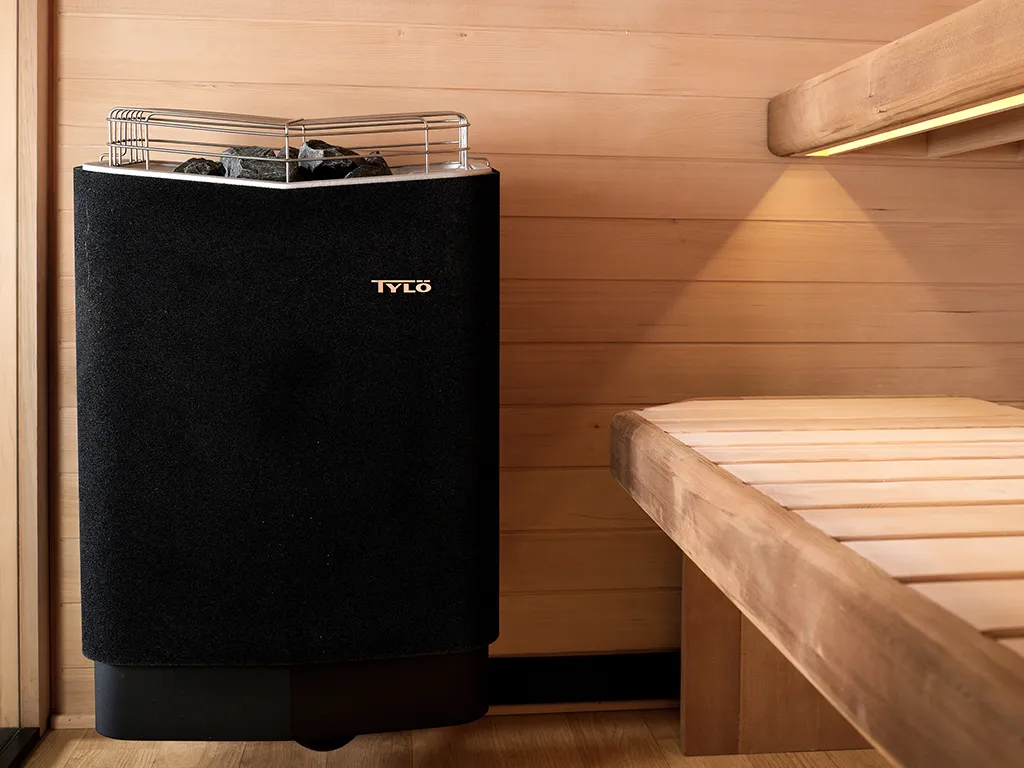
The Tylö Sense Bliss is the premium wall-mounted choice. The current Sense Bliss 6 and 8 models include stones, Tylö’s ThermoSafe protective siding, an aromatherapy reservoir, and Bliss controls with Tylö Sauna App connectivity. The wall-mounted format also preserves floor space.
Crown 8

The Tylö Crown 8 is a floor-standing 8.3 kW heater specified for rooms from 195 to 440 cubic feet. It includes 50 pounds of stones and adds integrated LED lighting, Bliss controls, app connectivity, and Tylö’s ThermoSafe siding.
This is the option for someone who wants the heater itself to contribute to the room’s design rather than disappear against a wall.
Sense Sport

The Tylö Sense Sport takes a more straightforward approach. Instead of app-based controls, Sense Sport models use built-in timer and temperature controls. The line includes multiple outputs for different room sizes and retains features such as wall mounting, ThermoSafe siding, and a 50-pound stone capacity.
For buyers who want reliable traditional sauna heat without prioritizing connected controls, Sense Sport is the simpler choice.
Sauna Stones: Why They Matter More Than You’d Think
The heater creates the heat, but sauna stones help determine how that heat is stored, distributed, and experienced.
Tylö uses heat-retaining volcanic stones designed to tolerate repeated heating and rapid cooling. They should be stacked loosely around the heating elements rather than packed tightly. Proper airflow helps the heater work efficiently and reduces unnecessary stress on its elements.
The stones also create löyly when water is poured over them. They aren’t permanent. Over time, repeated heating can cause stones to crack or crumble. Tylö recommends inspecting them periodically and replacing damaged stones rather than waiting until deteriorated material begins restricting airflow.
Sauna Wood Types Compared
The best wood for a sauna isn’t simply whichever species looks best in a showroom.
Sauna wood needs to tolerate dramatic changes in temperature and humidity without becoming unpleasantly hot to touch. Dimensional stability matters because the material repeatedly absorbs and releases moisture. Resin content, aroma, appearance, and cost can also change the experience.
Three common options illustrate the trade-offs particularly well.
Western Red Cedar
A cedar sauna has a character you notice immediately. Western Red Cedar is valued for its distinctive aroma, dimensional stability, natural resistance to decay, and relatively low density, which helps make it comfortable for sauna interiors and seating. It also offers more natural color variation than many sauna woods, ranging from pale yellow tones to rich, deep reds.
It’s particularly appealing when the traditional sauna smell is part of the experience you want. The tradeoff is price. Cedar is generally the premium choice of these three, and its characteristic aroma naturally becomes less pronounced over time.
Hemlock
Hemlock offers a different kind of appeal: clean, light, and understated.
Its mild scent makes a hemlock sauna a particularly useful option for people who don’t want cedar’s pronounced aroma. Clear hemlock also provides the clean, relatively uniform appearance many buyers associate with contemporary sauna interiors.
It generally costs less than cedar, making it a practical choice when you want a refined indoor sauna without paying primarily for cedar’s aroma and natural character.
Tylö uses clear hemlock in several of its current sauna collections, including its Halmstad traditional saunas.
Nordic White Spruce
Nordic White Spruce brings a light, natural appearance that fits particularly well with traditional Scandinavian sauna design. Its pale coloring keeps the interior bright, while visible grain and occasional knots give the wood more natural character.
Compared with cedar’s stronger aroma and wider color variation, Nordic White Spruce has a more understated appearance. It’s a good choice for homeowners who prefer a classic Nordic aesthetic and want the natural character of the wood to remain visible.
Cedar vs. Hemlock vs. Nordic White Spruce: Which Should You Choose?
| Factor | Cedar | Hemlock | Nordic White Spruce |
| Aroma | Distinctive | Mild/nearly neutral | Mild |
| Appearance | Pale yellow to deep red | Light, clean | Pale, natural |
| Natural character | High color variation | More uniform | Visible grain and occasional knots |
| Overall style | Warm, traditional | Clean, understated | Classic Scandinavian |
| Best fit | Owners who value aroma and rich natural color | Owners who prefer a lighter, subtler interior | Owners who prefer a natural Nordic aesthetic |
Cedar is a good fit if you like a stronger aroma and plenty of natural color variation. Hemlock is lighter and more subtle, while Nordic White Spruce has a pale, natural look that feels distinctly Scandinavian. Which one works best will largely come down to the Tylö model you choose and the look you want for the finished sauna.
What Wisconsin’s Climate Means for Your Sauna Build
Wisconsin makes the indoor-versus-outdoor distinction especially important.
An outdoor sauna has to deal with seasonal temperature swings, moisture, and repeated freezing and thawing conditions. That’s why the materials and construction of an outdoor sauna need to be designed for exterior use rather than chosen solely for appearance.
Indoor basement installations have a different priority: controlling moisture and ventilation so repeated sauna use doesn’t create problems in the surrounding structure.
Your sauna’s location should therefore influence the model, materials, and heater sizing before installation begins.
Electrical Requirements and Installation
Many full-size residential Tylö heaters operate on 240V power. The required amperage depends on the heater: for example, the Sense Bliss 6 is rated at 25 amps, while the Sense Bliss 8, Sense Sport 8, and Crown 8 are rated at 34.6 amps.
This isn’t a plug-and-play part of the project. Tylö requires electrical installation to comply with the National Electrical Code and local regulations, and its installation documentation specifies appropriate wiring and breaker requirements for each heater.
Wisconsin also regulates who may perform electrical wiring work, so heater wiring should be planned with an appropriately licensed electrical professional. Required clearances and any heater guard or safety requirements should come from the documentation for the exact heater being installed.
Heater Maintenance and Lifespan
A sauna heater doesn’t need complicated day-to-day maintenance, but it shouldn’t be ignored. Inspect the stones periodically for cracking or crumbling, and replace worn components as needed.
Bachmann’s carries sauna heaters and related accessories for ongoing heater care, while our Sauna Maintenance Guide covers how to care for the rest of the sauna over time.
See Tylö Saunas at Bachmann’s
The right sauna starts before you choose the panel color or lighting package. Get the heater output and wood right first, and the rest of the room has a much better foundation.
Explore Tylö Saunas at Bachmann’s or visit Bachmann’s in Madison or Brookfield to compare sauna options and get help sizing the heater for your planned room.
Sauna Heaters & Wood Types FAQs
What is the best wood for a sauna?
The best wood depends on the sauna and the look you prefer. Cedar stands out for its aroma and natural color variation, while hemlock is lighter and more subtle. Nordic White Spruce has a pale, natural look with visible grain and knots that suits a more traditional Scandinavian-style sauna. Your options will also depend on the specific sauna model you choose.
Can you pour water on any electric sauna heater?
No. Only pour water over a heater when the manufacturer specifically permits it. Traditional Tylö sauna heaters are designed to use appropriate sauna stones, but always follow the instructions for your exact heater model.
How long do sauna heater stones last?
There isn’t one replacement interval for every sauna. Usage determines how quickly stones deteriorate. Inspect them regularly for cracking and crumbling and replace damaged stones before they begin restricting airflow through the heater.