





You bought a pool to swim in it, not to spend your summer feeling like you need a chemistry degree to maintain it.
The good news? Pool water chemistry is much simpler once you understand what you’re actually testing and why.
A few key levels determine whether your water stays clear, comfortable, and properly sanitized. Get those basics right, establish a consistent testing routine, and maintaining pool water chemistry quickly becomes just another part of pool ownership.
Here’s what every pool owner should know.
TL;DR: Pool Water Chemistry at a Glance
For clean, balanced pool water:
- Test your water regularly rather than relying on how it looks.
- Keep an eye on pH, total alkalinity, calcium hardness, and sanitizer.
- Monitor cyanuric acid when it’s relevant to your chlorine system.
- Correct imbalances before they turn into cloudy water, algae, scale, or equipment problems.
- Follow the recommendations for your specific water care system instead of mixing different systems or adding chemicals at random.
- When you’re unsure, have your water professionally tested before adding more chemicals.
Think test, balance, sanitize, maintain, not “throw something in and hope for the best.”
The Key Elements of Ideal Pool Water Chemistry
What does perfect pool water chemistry actually mean?
It’s not about chasing one magical number. Water balance comes from several factors working together.
pH
pH tells you how acidic or basic your pool water is.
When pH drifts too far in either direction, you may notice swimmer discomfort, scaling, cloudy water, or problems with pool surfaces and equipment. pH also affects how efficiently chlorine works, making it one of the most important numbers to watch. According to the CDC’s Model Aquatic Health Code, maintaining proper water chemistry is essential for effective disinfection and swimmer safety.
For many residential pool care programs, you’ll commonly see a recommended pH range around 7.2–7.8, although you should always follow the range specified for your particular water care system.
Total Alkalinity
Think of total alkalinity as pH’s stabilizer.
When alkalinity is properly balanced, it helps prevent pH from bouncing dramatically up and down. If you’re constantly adjusting pH only to see it change again, alkalinity is one of the first things worth checking.
Calcium Hardness
Calcium hardness measures the amount of dissolved calcium in your pool water.
Too little or too much can contribute to water balance problems and potentially affect pool surfaces and equipment over time. The ideal level depends partly on your pool construction and water care program.
Sanitizer
Sanitizer is what helps control bacteria and keep the water safe for swimming.
For many pools, that’s chlorine. However, chlorine isn’t your only option. Bachmann’s also offers alternative water care approaches, including saltwater systems that generate chlorine and chlorine-free biguanide systems.
Cyanuric Acid
Cyanuric acid, often called stabilizer, helps protect chlorine from breaking down too quickly in sunlight.
It’s useful in appropriate chlorine-based outdoor pools, but more isn’t necessarily better. Your target should depend on the sanitizer and pool care system you’re using.
Together, these levels create the foundation for ideal pool water chemistry.
How to Test Your Pool Water
Here’s one of the best habits you can develop as a pool owner:
Don’t guess based on how the water looks. Test it. Crystal-clear water can still have chemistry that needs attention.
Test Strips
Test strips are fast and convenient for routine checks. Dip the strip according to its instructions, wait the specified amount of time, and compare the colors with the chart provided.
They’re particularly useful for quick checks throughout the swimming season.
Liquid Test Kits
Liquid testing kits require a little more effort but allow you to measure important aspects of swimming pool water chemistry at home.
Whichever method you choose, consistency matters more than waiting until something looks wrong.
Test regularly and pay extra attention after heavy swimming, major rain, unusually hot weather, or whenever the water starts behaving differently.
Professional Water Testing
Sometimes the easiest solution is to let someone who works with pool water every day take a closer look.
Professional testing can give you a more complete picture of what’s happening and help prevent the common mistake of adding one chemical after another without knowing what actually needs correcting.
Bachmann’s offers water care support at its Wisconsin locations, so when your numbers have you scratching your head, bring in a water sample and get guidance before turning your pool into a chemistry experiment.
Pool Water Care Systems at Bachmann’s
There’s no single water care routine that’s perfect for every pool owner.
Some people prefer traditional chlorine. Others want a saltwater experience or would rather avoid chlorine entirely.
Bachmann’s offers several options so you can find a routine that works for your pool and the amount of maintenance you’re comfortable with.
Saltscapes Saltwater Pool Care System

Want pool care to feel a little less hands-on?
The Saltscapes Saltwater Pool Care System is designed for pools equipped with chlorine generators. Rather than manually adding traditional chlorine as the primary sanitizer, the generator uses salt in the water to produce chlorine.
Bachmann’s SaltScapes options are designed to simplify saltwater maintenance, including programs with straightforward weekly care.
Saltwater pools are popular with homeowners looking for a gentler-feeling swimming experience and a simplified approach to routine sanitizing.
One important distinction: saltwater doesn’t mean chlorine-free. A saltwater generator still produces chlorine to sanitize the water.
Baquacil Chlorine-Free Water Care

If avoiding chlorine altogether is the priority, Baquacil Water Care takes a different approach.
BAQUACIL uses a biguanide-based sanitizer rather than chlorine and follows a three-part routine built around sanitizer, oxidizer, and algae control.
That makes it an option worth exploring for swimmers who experience irritation from chlorine or families who simply prefer a chlorine-free pool.
Bachmann carries BAQUACIL pool maintenance products at its Brookfield showroom and can help you understand how the system differs from traditional chlorine care.
BioGuard Pool Care

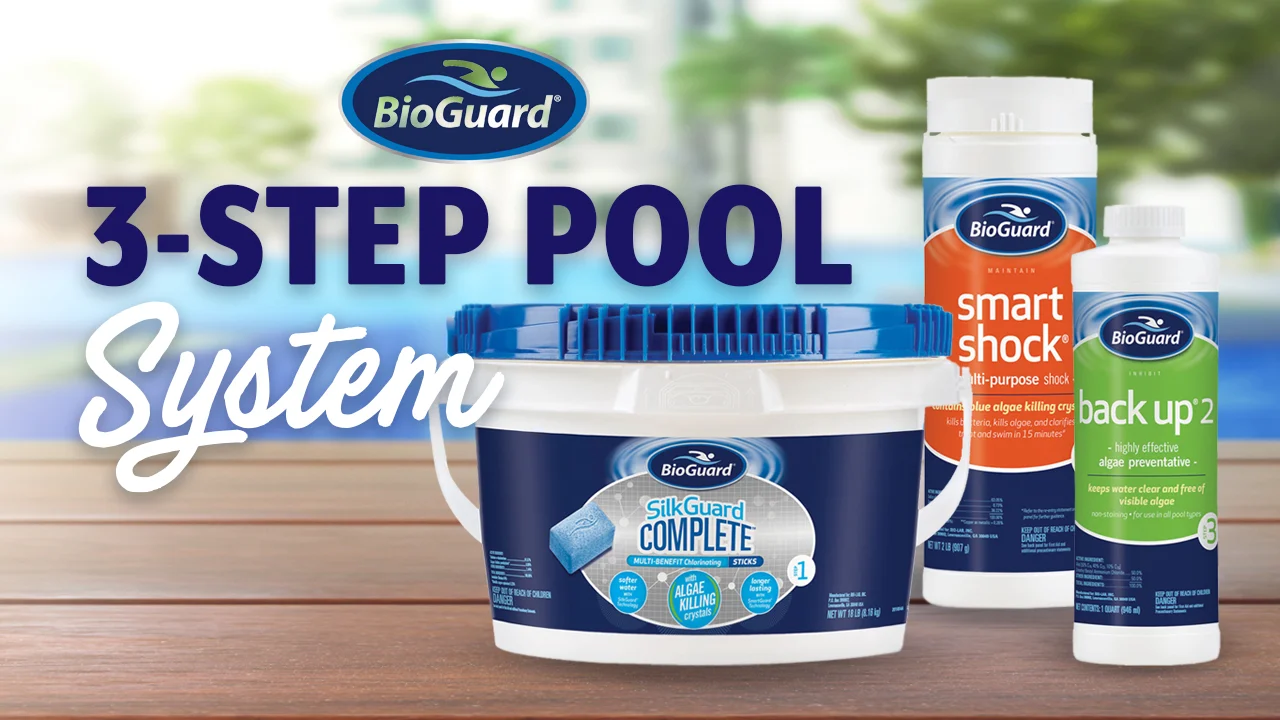
For homeowners using more traditional pool care routines, BioGuard offers products covering the major parts of water maintenance, including sanitizing, shocking, water balancing, algae prevention, cleaning, and seasonal care.
Instead of piecing together a routine based on whatever bottle happens to be nearby, you can build a more consistent water care program around what your pool actually needs.
How to Balance Pool Water Chemistry
So, your test results are in. Now what?
The first rule is simple: don’t try to fix everything at once.
When learning how to balance pool water chemistry, work systematically and follow the directions for your specific products and sanitizer system.
A practical approach is to:
- Test first. Know what’s actually high or low before adding anything.
- Address total alkalinity. Because alkalinity helps stabilize pH, correcting it first can make subsequent pH adjustments easier.
- Adjust pH. Bring it into the recommended range for your water care system.
- Check calcium hardness. Correct it when necessary based on your pool type and system.
- Verify sanitizer levels. Make sure your chlorine or alternative sanitizer is within its recommended range.
- Check stabilizer where applicable. Cyanuric acid matters for many outdoor chlorine pools, but requirements vary by system.
- Circulate and retest. Give treatments time to distribute according to product directions before assuming you need more.
And remember: more pool chemicals don’t automatically mean cleaner water.
Adding products without testing can create a new imbalance while you’re trying to fix the first one.
How to Maintain Pool Water Chemistry Without Overthinking It
Once your water is balanced, keeping it that way is much easier than repeatedly rescuing a pool that’s been neglected.
The secret to how to maintain pool water chemistry isn’t complicated.
Stay consistent.
Test your water regularly. Keep sanitizer at the appropriate level. Clean and circulate the water properly. Watch for changes after storms, heat waves, or busy swimming weekends. And address small imbalances before they become big ones.
Don’t forget the physical side of pool maintenance either. Your filter, circulation system, pool surfaces, and pool liner all play a role in keeping your pool in good condition.
If you own or are considering one of Bachmann’s Radiant pools, establishing a water care routine from the beginning can make ownership much easier.
The goal isn’t to obsess over your water every day.
It’s to create a routine predictable enough that you don’t have to.
Keep Your Pool Water Perfectly Balanced with Bachmann’s
Pool chemistry shouldn’t be the part of pool ownership you dread.
Once you know which numbers matter, test consistently, and use a water care system that fits your lifestyle, maintaining clean and comfortable water becomes much more manageable.
And you don’t have to figure it all out alone.
Visit Bachmann’s for pool chemicals, water testing, and expert help choosing between traditional water care, saltwater options, and chlorine-free systems. Bring in a water sample, find out what your pool actually needs, and spend less time wondering what’s happening in the water and more time enjoying it.
Related Post – Pool Opening & Closing in Wisconsin
Pool Water Chemistry FAQs
What is the ideal chemistry for a swimming pool?
Ideal swimming pool water chemistry means keeping pH, total alkalinity, calcium hardness, sanitizer, and other system-specific levels within their recommended ranges. There isn’t one universal set of “perfect” numbers for every pool, so follow the targets specified for your sanitizer, pool surface, and water care system.
What are the ABC’s of pool water chemistry?
Start with three fundamentals: balance, sanitize, and test consistently. Balance pH, alkalinity, and calcium hardness; maintain the correct sanitizer level to control bacteria and algae; and test regularly so you can correct small changes before they turn into cloudy water or larger maintenance problems.
What is the correct order for pool chemicals?
Test the water before adding anything. When adjustments are required, alkalinity is commonly addressed before pH because it helps stabilize pH. Then correct other balance factors and verify sanitizer according to your specific system. Always follow product instructions, avoid mixing pool chemicals, and retest before making additional adjustments.